Company work · Tatsu Works Pte. Ltd. — Sensitive metrics and internal deliverables are available upon request in an interview setting.
Customer Journey Map
Designing user-centric products begins with understanding how customers experience the product over time.
Problem
The product was facing retention challenges with inconsistent engagement patterns and unclear drop-off points. Mixed user feedback revealed a gap between design intentions and actual user motivation.
Expected Outcome
Improved retention and engagement through persona-driven design decisions, with reduced churn by addressing key friction points at critical stages of the journey.
Context
Retention challenges rarely have a single cause. Different users drop off at different stages for different reasons, each driven by distinct motivations and expectations. The only way to address retention meaningfully is to map the actual user experience, not the intended one.
My Role
I synthesized research and product data into clear, actionable customer journey maps across three key user personas, translating complex findings into strategic design opportunities.
Process
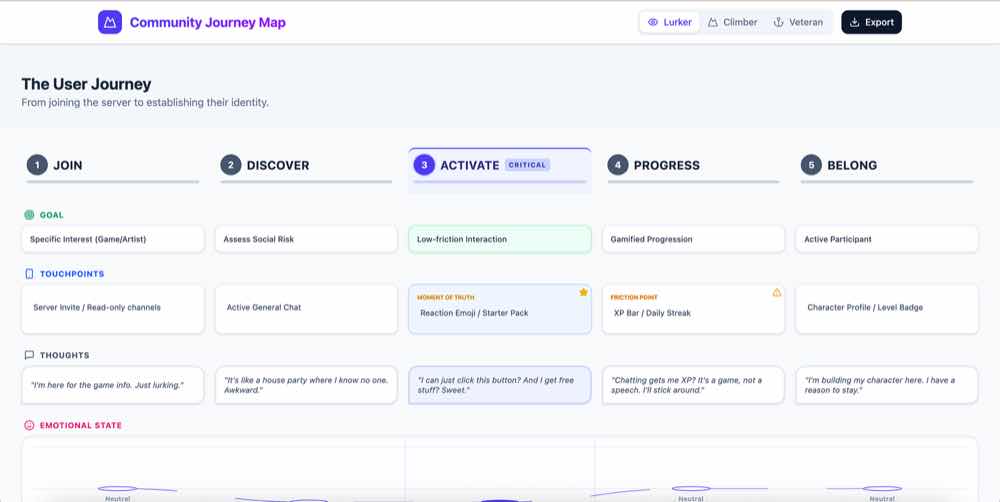
- 1Gathered research and behavioral data across user types
- 2Identified three distinct personas with unique motivations
- 3Mapped full user journeys from Join to Belong
- 4Located Moments of Truth and Friction Points per persona
- 5Translated findings into targeted design opportunities
Personas Mapped
The Lurker
Silent majority. Waiting for a low-risk reason to engage.
The Climber
Motivated by status, competition, and visible progress.
The Veteran
Former champions. Idle but not gone.
Journey Stages
- 1 · Join
- 2 · Discover
- 3 · Activate
- 4 · Progress
- 5 · Belong
Core Insight
The Assumption
“Design for more engagement.”
The Reality
“Design for the right motivation at the right moment.”
Designing for “more engagement” alone leads to noisy, short-term interactions that resemble slot-machine behavior rather than meaningful product value. Each persona needs a different design response, not a louder version of the same one.
The Three Personas
Each persona carries different motivations, fears, and success criteria. A single design response cannot serve all three. The journey maps made this structurally clear.
The Lurker
The silent majority. Waiting for a low-risk reason to engage.
“I'm interested, but jumping into chat feels like walking into a party alone.”
Motivation
Progress without social pressure. Tangible rewards for low effort.
Fear
Social awkwardness, wasted effort.
Success Looks Like
I am progressing without having to be loud.
Risk Factor
Lack of engagement or recognition.
Critical Stage
Activate
Moment of Truth
Reaction Emoji / Starter Pack
Friction Point
XP Bar / Daily Streak
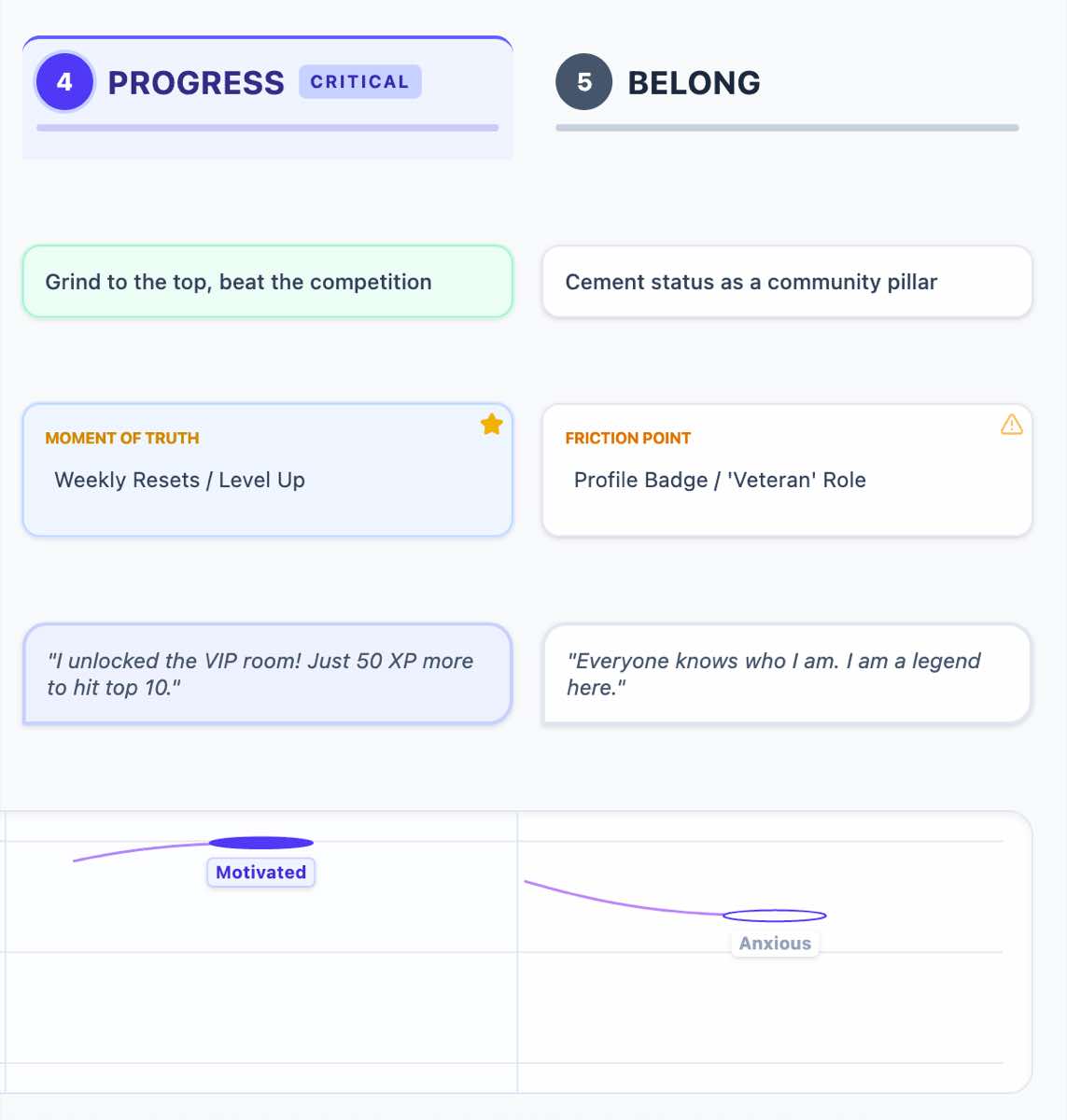
The Climber
Highly motivated by status, competition, and visible progress.
“I want to be seen, recognized, and known.”
Motivation
Status, rank, and proof of effort. Public validation through leaderboards.
Fear
Being overlooked, hitting a ceiling, irrelevance.
Success Looks Like
Everyone knows who I am.
Risk Factor
Progress stalls, recognition dries up, or a 'ceiling' is hit.
Critical Stage
Progress
Moment of Truth
Weekly Resets / Level Up
Friction Point
Profile Badge / Veteran Role ceiling
The Veteran
Former champions who have 'completed' the product. Idle but not gone.
“I've done it all. Give me a reason to come back that respects my time.”
Motivation
Legacy recognition. Collection, completionism, helping others.
Fear
Irrelevance, being forgotten, forced restart.
Success Looks Like
My past contributions are visible and valued.
Risk Factor
Lack of engagement or recognition.
Critical Stage
Belong
Moment of Truth
Hall of Fame / Legend Role
Friction Point
Event Contribution
Moments of Truth & Friction Points
The moment of truth and the friction point sit side by side in every persona's journey. The design challenge is to make the right moment land before the friction takes hold.
Key Findings & Behavioral Insights
Three behavioral patterns emerged that directly inform product decisions around onboarding, progression systems, and long-term retention.
House Party Syndrome (Lurker)
Lurkers aren't lazy. They're socially blocked. Jumping into active chat feels like entering a party where everyone knows each other. Low-effort, high-payoff interactions are the unlock. Make chat feel like a game, not a performance.
Status Nobody Sees Is Not Status (Climber)
Climbers are active but need somewhere to go. Without clear goals, rewards, or recognition, servers feel stale. Automate visibility through profile cards and announcements. The race is the content.
The Museum Problem (Veteran)
If a server feels like a museum of a Veteran's past, they leave. They need fresh challenges that respect their legacy. Reactivation framing must be 'Your unique power is needed,' not 'You missed out.'
Mentor or Grinder?
Not all Veterans want to teach. Some just want to contribute to community goals without the daily leaderboard grind. A permanent record of achievements (Passport, Trophy Cabinet) validates their history without requiring constant re-engagement.
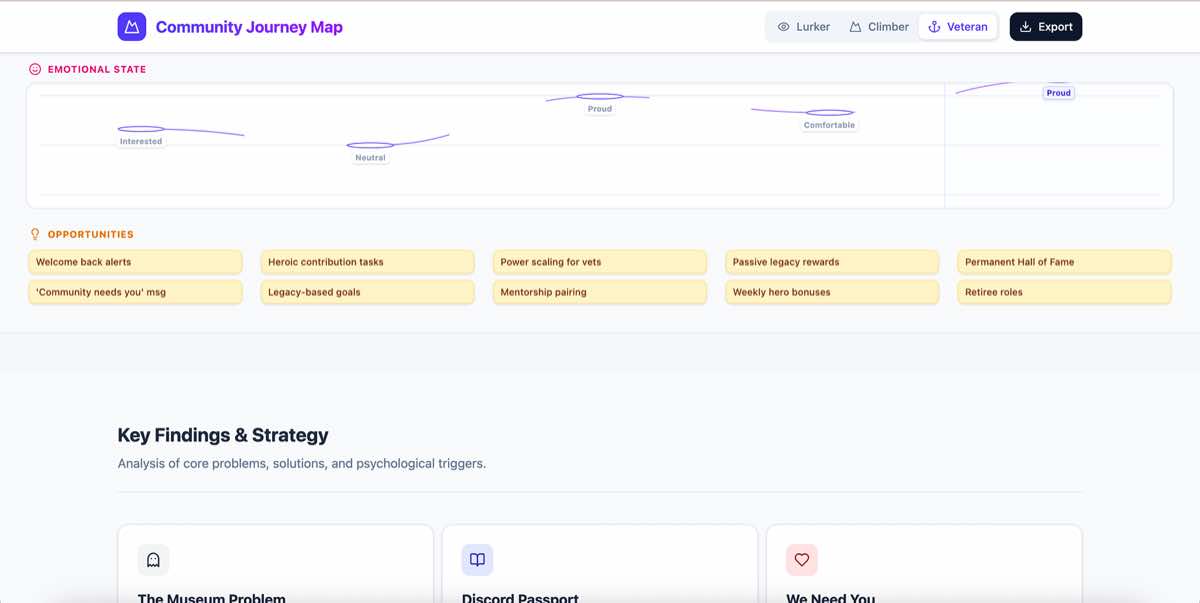
Design Opportunities
Each persona's journey revealed targeted opportunities to reduce friction and reinforce the right motivations at the right moment.
For Lurkers
For Climbers
For Veterans
Reflection
This project reinforced that there is no single solution that fits all users. Each persona engages with the product differently, driven by distinct motivations and expectations.
Designing for “more engagement” alone can lead to noisy, short-term interactions that resemble slot-machine behavior rather than meaningful product value.
Instead, effective design requires aligning features with the right user motivations at the right moments. By translating insights into clear design principles and decision rules, we can prioritize what truly drives long-term retention and product success.
If I were to extend this work, I'd map the Server Owner persona next to complete the full ecosystem view, and validate these design opportunities through user testing with real Lurker and Climber cohorts.