Company work · Tatsu Works Pte. Ltd. Sensitive metrics and internal deliverables are available upon request in an interview setting.
AI-Assisted Message Creation for Discord Server Owners
Reducing technical barriers in Discord message creation through AI-assisted UX
Problem
Advanced Discord messaging is inaccessible to non-technical server owners, limiting feature adoption and community quality.
Outcome (Directional)
Designed an intent-driven AI UX system that reduces technical dependency, accelerates server setup, and unlocks new community segments.
Context
Discord is expanding beyond gaming into media, education, and creators, but messaging quality directly impacts retention. High-frequency actions with low UX quality compound into ecosystem-level friction, making message creation both a daily task and a technical bottleneck.
My Role
I independently identified the problem, conducted workflow analysis, and designed the end-to-end AI-assisted solution, including product framing, UX principles, and system behavior.
Process
- 1Reviewed existing tools (Discohook, embed builders)
- 2Mapped message creation workflow & friction points
- 3Explored solution directions (templates vs AI vs improved builders)
- 4Developed AI UX principles to guide system design
Designed For
Server owners
50–50k+ members, often solo
Community managers
Engagement, events, announcements
Non-technical designers
Visual thinkers who can’t code embeds
Constraints
- • Discord API & component limitations
- • Non-technical user mental models
- • Risk of AI-generated generic messages
- • Need for real-time feedback & control
AI UX Principles I Developed
Intent Before Structure
Start with what users want to say, not how Discord formats it.
Constrained Generation
AI outputs must stay within current platform capabilities. No speculative features.
Section-Level Control
Users can regenerate, edit, or lock individual message components, never all-or-nothing.
Transparent Boundaries
The system clearly communicates what AI can and cannot do at every step.
Core Reframe
From
“How do I configure this message?”
To
“What do I want to communicate?”
AI acts as a translator between intent and platform constraints, not an autonomous creator.
Proposed System
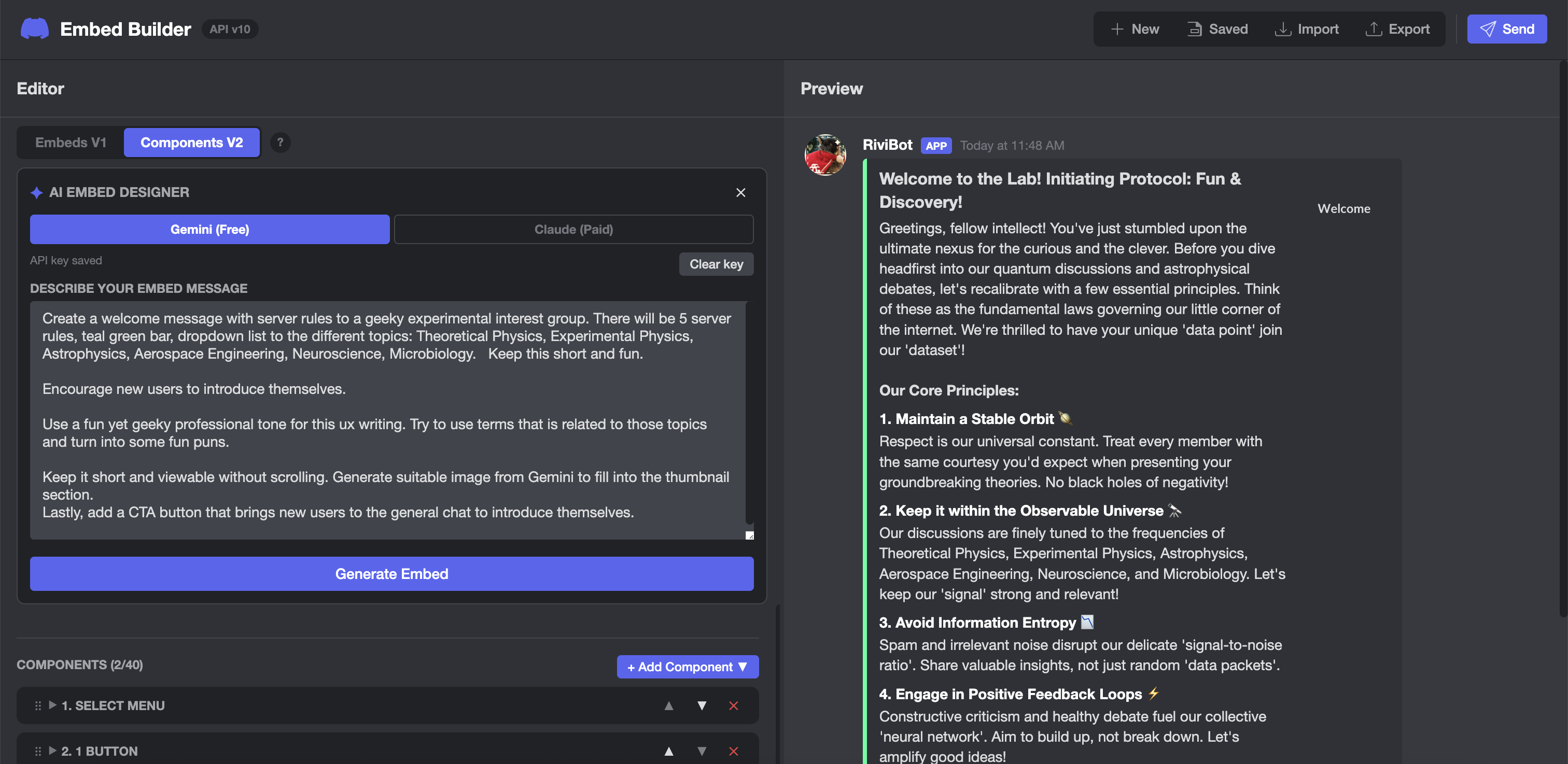
An AI-assisted message builder embedded in a Discord-native workflow that:
- • Accepts natural language intent
- • Generates platform-valid messages
- • Supports conversational refinement
- • Preserves human control
What This Is Not
- • Not a one-click generator
- • Not a static template library
- • Not a replacement for human judgment
V2 → Legacy Conversion
Messages built with V2 components convert seamlessly to legacy format. No existing tool offers preview for V2 components or automated conversion between formats.
Component Reordering
Drag to reorder components in and outside of groups. Existing tools don't support this, so repositioning means rebuilding from scratch.
Key Decisions
Four design decisions that shaped the system
Each decision was evaluated against alternatives and grounded in real constraints.
AI Over Templates
Use AI-driven generation instead of expanding template libraries.
Competitive audit of 12 community platforms showed templates covered less than 30% of real-world message use cases, and lagged months behind feature releases.
Alternatives Considered
- • Pre-built message templates
- • Improved embed builders
Why Not
- • Templates don't scale across industries
- • They lag behind new platform features
- • They constrain expression
Impact
AI enables intent-based creation that adapts as Discord evolves.
Conversation-First UX
Design message creation as a conversational flow rather than a form-based builder.
Flow analysis of existing embed builders revealed 7+ sequential form fields before any preview, a pattern that drove abandonment in usability heuristic review.
Alternatives Considered
- • Step-by-step configuration UI
- • Advanced visual editors
Why Not
- • Forms increase cognitive load
- • Users must understand structure before intent
Impact
Conversation lowers the barrier to entry and encourages iteration.
Human-in-the-Loop by Default
Ensure all AI outputs are editable, previewable, and regenerable by section.
Pattern analysis of AI writing tools (Jasper, Copy.ai, Notion AI) showed highest satisfaction when users could regenerate individual sections rather than full outputs.
Alternatives Considered
- • One-shot generation
- • Locked outputs with minor edits
Why Not
- • Over-trust in AI degrades quality
- • Users lose ownership
Impact
Maintains trust, agency, and message quality.
Platform-Aware Constraints
Constrain AI outputs to current Discord UI capabilities.
Discord API changelog analysis showed 3 breaking changes to embed structure in 12 months. Speculative generation would produce invalid outputs within weeks.
Alternatives Considered
- • Flexible, speculative generation
- • Post-generation validation errors
Why Not
- • Invalid outputs confuse non-technical users
- • Errors feel like personal failure
Impact
Prevents hallucination and reduces frustration.
North Star
Weekly active servers using structured messages
Primary Metrics
• Time to first structured message
Target: ~30 min → under 5 min
• Adoption of advanced components
Target: <10% → 40%+ of active servers
• Non-gaming server categories
Target: Measurable growth in education, media, creator segments
Guardrails
- • AI override rate
- • Invalid message rate
- • Abuse and spam signals
Impact
What changed because of this work
Engineering Dependency
Before
Message creation required engineering handover and bot implementation.
After (Expected)
Server owners can create and deploy structured messages directly, without engineering support.
Workflow Fragmentation
Before
Message creation relied on external tools, requiring context switching and manual integration.
After (Expected)
Message creation happens within a Discord-native workflow, reducing friction and errors.
Before
Users needed to understand Discord's technical constraints to avoid invalid messages.
After (Expected)
AI translates intent into platform-valid messages, removing the need for technical knowledge.
Message Quality & Confidence
Before
Non-technical owners defaulted to plain text or avoided structured messages entirely, resulting in lower engagement.
After (Expected)
AI-assisted creation enables rich, well-formatted messages from any skill level, raising baseline quality across all servers.
Before
Users had no way to preview or validate messages before posting, leading to trial-and-error in live channels.
After (Expected)
Real-time preview and section-level editing give users confidence before they publish.
Reflection
This project shifted my perspective on AI UX from automation to control design. While AI can remove friction in message creation, I observed from managing our own Discord community that server owners don't just want speed. They want their servers to feel distinct and intentional, not templated or generic.
The key challenge became deciding where AI should lead and where users must remain in control, without increasing cognitive load. That tension between making things easier and keeping things personal shaped every design decision in this project.
Rather than designing AI that replaces the creative process, I focused on designing clear control points around intent, structure, and refinement. The goal was to make AI feel like a capable collaborator, not a black box that outputs content users don't fully own.
If I could revisit my process, I'd bring in server owners earlier. Even for a conceptual project, lightweight co-design sessions would have stress-tested assumptions about what “control” actually means to different user types. I leaned on heuristic analysis and competitive audit, which shaped the system well, but real voice-of-user data would have sharpened the refinement loop design.
If I were to take this further, I'd explore how these patterns scale across communities with very different cultures, from tight-knit hobby groups to large public servers, and how the system adapts without losing the sense of ownership that makes each community unique.